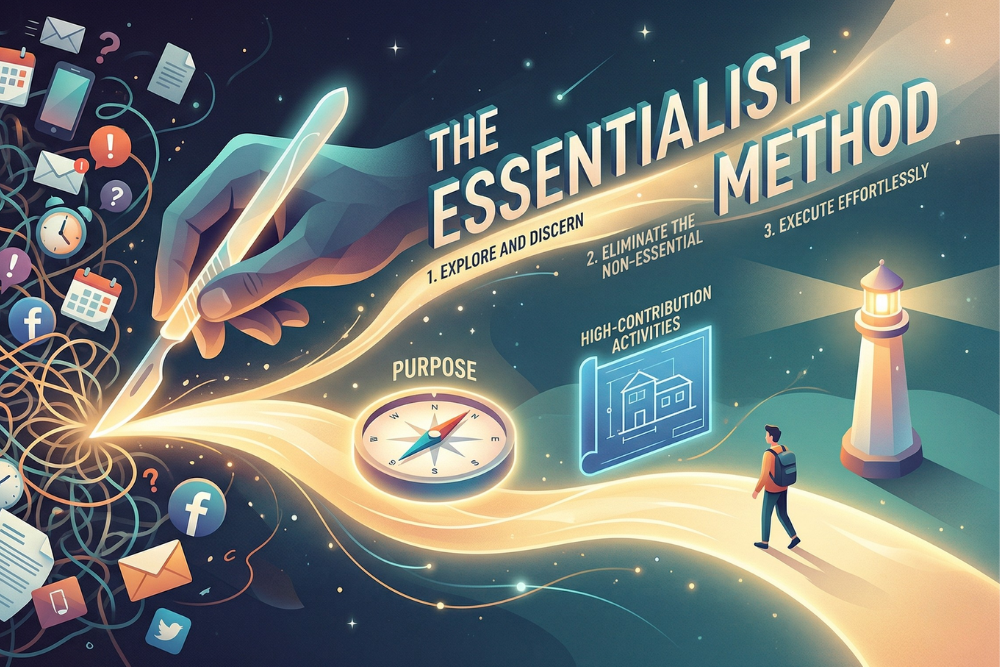
If you work from home, you already know the truth: your biggest enemy isn't laziness. It's noise. Notifications, micro-tasks, endless tabs, Slack pings, «quick calls», and the constant pressure to be always on. Here's what nobody tells you: most of what fills your day doesn't actually matter. And the exhaustion you feel? That's not from working hard. That's from working scattered.
The Problem: Remote Work Promised Freedom, But Delivered Chaos
When you started working from home, the pitch was simple: more flexibility, better focus, no office distractions. The reality? Work hours bleed into personal hours. Every room becomes a potential office. Every device becomes a potential distraction. Every message feels urgent. You're checking Slack while making breakfast. Answering emails during lunch. Taking «quick calls» at 8 PM because technically you're still home, so you're still available.
The result? You're always working, but never actually producing anything that moves the needle.
The numbers back this up: Studies show remote workers put in 2.5 more hours per day than office workers, yet report lower satisfaction with their output. Translation: we're doing more, but feeling worse about it.
Here's what happens if you don't fix this: burnout becomes your default state. Your best work never surfaces because you're too busy managing the noise. And three years from now, you'll still be stuck in the same scattered, exhausting cycle.
The Solution: Minimalist Productivity (Essentialism for the Digital Era)
Minimalist productivity is the discipline of doing fewer things, better. Not fewer tasks for the sake of simplicity. Fewer tasks because most tasks don't move the needle. It's built on three principles: clarity, reduction, and focus. You need to know exactly what matters today, remove everything that doesn't, and protect your attention like a scarce resource. This isn't a hack. It's a worldview. When you do less, you think better. When you think better, you produce better. When you produce better, you win.
The Five-Step Essentialist Framework
Step 1: Define the One Outcome That Matters Today
Not a to-do list. Not five priorities. Just one essential outcome. Ask yourself: «If I only completed one thing today, what would make the day successful?» That's your North Star.
Most people fail here because they confuse motion with progress. They fill their task list with easy wins-checking email, organizing files, attending meetings. But easy doesn't equal important.
Example: I used to start my day with a 12-item to-do list. Felt productive crossing things off. But at the end of the week? I couldn't point to anything meaningful I'd created.
Now I start with one outcome. «Finish the client proposal.» «Ship the new feature.» «Write the strategy doc.» Everything else is optional noise. This single shift changed everything.Step 2: Ruthlessly Delete Non-Essential Tasks
Most tasks are optional. Most meetings are avoidable. Most emails don't need a reply. Delete first. Delegate second. Do last. Here's the test: if this task disappeared tomorrow, would anyone actually notice? If the answer is «probably not», delete it.
The 90% rule:
If something isn't a «hell yes», it's a no. You don't need a good reason to decline—you need a good reason to accept. This feels harsh at first. But here's what I learned: people respect boundaries. When you stop saying yes to everything, the requests actually decrease. Your availability shrinks, so people stop treating your time as infinite.
Step 3: Time-Box Your Work Into a Single Deep-Work Block
One 60-120 minute block of uninterrupted focus outperforms a full day of scattered effort. During this block, you need complete isolation: no notifications, no multitasking, no switching tabs, no «quick checks». This is where your essential work happens.
The science: Your brain takes 23 minutes to fully recover from an interruption. If you're checking Slack every 15 minutes, you're never actually focused. You're context-switching all day, which burns energy without producing results.
Book your deep-work block like a meeting. Literally put it on your calendar. Treat it as non-negotiable. I do mine 9-11 AM. Phone on airplane mode. Slack closed. Email closed. Just me and the one essential outcome. Those two hours produce more value than the entire rest of my day combined.Step 4: Build a Minimalist Digital Environment
Your digital space is your mental space. Strip it down: one browser window, one project open, one communication channel checked at set times, one simple task manager. Not a complex system you spend hours maintaining. Minimal tools, maximal clarity.
Here's what this looks like in practice:
I use a single text file for my daily task list. Three items max. No fancy app. No color-coding. No priority levels. Just three things. Email gets checked twice a day: 11 AM and 4 PM. That's it. If something is truly urgent, people will call. Slack stays closed during deep work. I batch-check it during transition periods. Desktop stays empty. No files, no clutter, just a clean background. This sounds extreme until you try it. Then it feels like breathing room.
Step 5: End the Day With a 3-Minute Reset
Close loops. Clear your desk. Write tomorrow's one essential outcome. This tiny ritual prevents mental residue and protects your energy.
Why this matters: When you leave work without closure, your brain keeps processing. You're «off» the clock but not mentally off. The tabs stay open in your head.
The 3-minute reset gives you permission to stop. You've defined tomorrow's focus, so there's nothing left to figure out tonight. My reset looks like this: close all apps and browser tabs, clear my desk, write tomorrow's one outcome on a sticky note, then walk away. That's it. No elaborate shutdown ritual. Just clean closure.The Unexpected Benefits of Doing Less
Minimalist productivity creates a ripple effect. You get higher quality output because your attention is undivided. Lower stress because your workload is intentionally small. More creativity because your mind has space. More consistency because the system is simple enough to sustain. More freedom because you're no longer drowning in obligations. Doing less isn't lazy. It's strategic.
The Work-From-Home Minimalist Productivity Starter Kit
You don't need complex systems. You need clear boundaries. Here's the entire setup: a single-purpose workspace (even a corner counts), a daily «one-outcome» card or sticky note, a 90-minute deep-work block, a minimalist task list (3 items max), a strict «no notifications during work» rule, and a 3-minute end-of-day reset. This is the entire system. Everything else is optional. Try it for one week. Just one. Don't add complexity. Don't customize it yet. Run it as-is. You'll notice the difference by day three.
Final Thought: Productivity Isn't About Volume - It's About Direction
Most people are drowning in tasks. Essentialists are moving with intention. When you strip away the non-essential, you don't just get more done. You become the kind of person who only does what matters. And that's the real art of minimalist productivity. Ready to try this? Start tomorrow. Define your one essential outcome tonight. Protect your deep-work block. Delete everything else. Or keep the chaos. Your choice. But if you're tired of being busy without being productive, you know what to do. Drop a comment below with your one essential outcome for tomorrow. Let's see what you're focusing on. And if this clicked for you, check out more productivity frameworks on the main channel.